
The close of the 2025 financial year paints a clear picture: foreign demand is not only resilient but remains strong in absolute terms. Although its relative share of total sales stood at 13.52%, the fourth quarter saw just over 24,200 purchases by international buyers, surpassing the 23,700 recorded in the previous quarter. This momentum cements a year in which international investment has approached 100,000 transactions.
Analysis by nationality reveals a changing of the guard: the British (7.93%) remain in the lead, but the Dutch ‘sorpasso’ is now a reality. With 6.77% of the market, the Netherlands has overtaken Germany (6.65%) in terms of transaction volume. This momentum stems mainly from the European Union, which accounts for 57.32% of purchases and pays an average price of €3,010 per square metre, well above the national average.
The market’s strength is so widespread that, in this last quarter, nine autonomous communities have recorded increases in the proportion of foreign purchases. This figure demonstrates that the appetite for Spanish property is successfully expanding beyond traditional hubs, even in a scenario where North American citizens lead spending with an average of €4,381 per square metre.
Prices at record highs: the challenge of a demanding market
Official data from the Association of Registrars paints a picture of a robust market, but one that is also becoming more demanding. The average house price reached €2,354 per square metre in the fourth quarter of 2025, a new all-time high representing a quarterly increase of 2.2% and bringing the year-on-year rate to a solid 9.5%.
This price milestone is particularly significant for foreign buyers, especially given that new-build homes are now priced at €2,500 per square metre. Although Spain remains a clear investment opportunity, buyers must now navigate a market characterised by record highs in both sectors (new-build and second-hand), where profitability depends more than ever on a meticulous selection of properties and impeccable tax management.
Source: Property Registry Statistics (ERI), Association of Registrars.
Geographical concentration: Alicante and Murcia, leaders in foreign demand
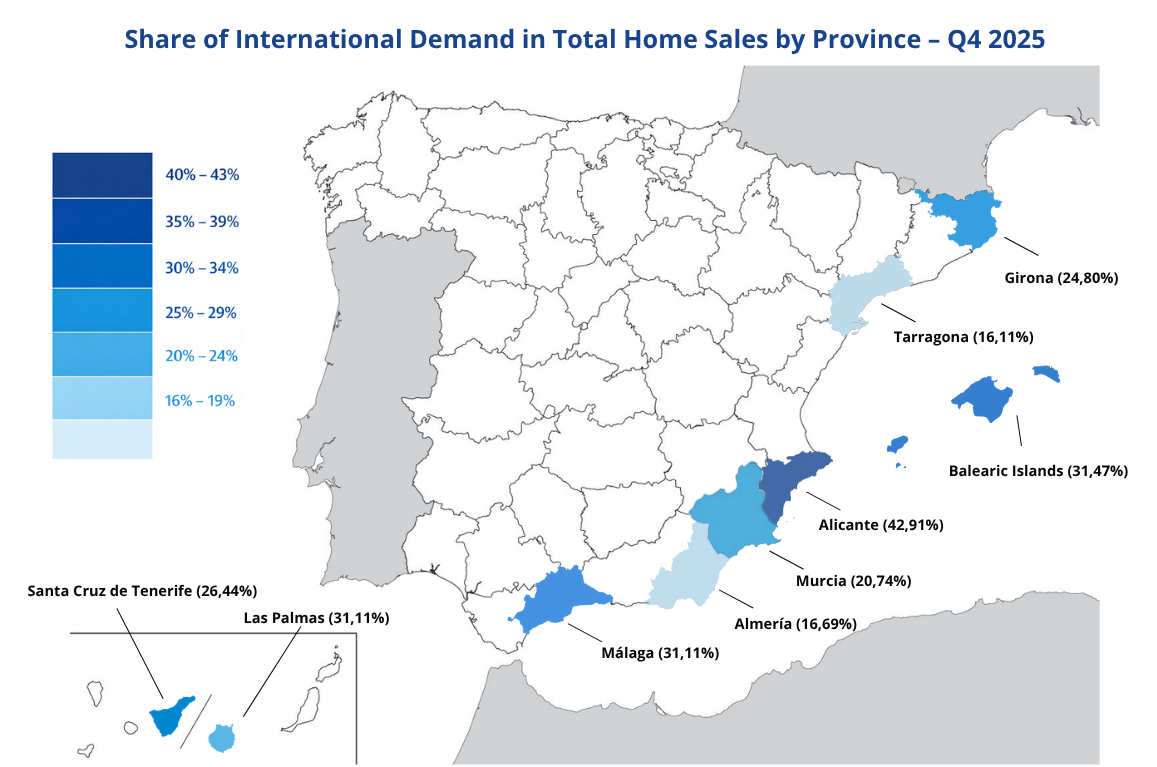
The geographical distribution follows a pattern shaped by the tourism industry, with extraordinary strength along the Mediterranean coast. Alicante leads decisively at the national level: 42.91% of its purchases were made by foreigners in the fourth quarter, following a solid increase of 2.59 percentage points compared to the previous quarter.
The ranking of provinces with the highest foreign share is completed by the Balearic Islands (31.47%), Málaga (31.11%), Santa Cruz de Tenerife (26.44%) and Girona (24.8%). For its part, the Region of Murcia also shows significant strength, standing at 20.74%, whilst Almería brings up the rear of the leading group with 16.69%.
‘It is no coincidence that the foreign share is so high in these areas,’ notes Pedro Martínez, CEO of Fuster & Associates. ‘Investors are looking for safe havens. Although we are seeing slight adjustments in the relative share of some provinces this quarter, the absolute volume remains extremely high. Towns such as Los Alcázares or San Pedro del Pinatar in Murcia continue to attract a demographic seeking a winning combination of price and quality of life.’
Prices and financing: the €2,354/m² challenge
The national average price has closed at €2,354/m² (+2.2% quarter-on-quarter), marking a new all-time high. However, the analysis by Fuster & Associates focuses on new-build homes, which have already reached €2,500/m² (+3.7%). This scenario of record prices, coupled with an average mortgage debt per property of €171,177 (another all-time high following a 2% quarterly rise), means that advice on financing is now the determining factor.
Against this backdrop, affordability indicators have deteriorated further. With an average interest rate of 2.97% and a monthly mortgage repayment of €796.6 (1.3% higher than the previous quarter), the financial burden now accounts for 33.8% of the average wage in Spain. Faced with this reality, foreign buyers must enter the market with a clear strategy and prior financial due diligence to ensure that the cost of debt does not compromise the profitability of the transaction.
Source: Property Registry Statistics (ERI), Association of Registrars.
The price map is, now more than ever, a landscape of contrasts. Whilst Madrid and the Balearic Islands have broken the €4,100 barrier, the interior continues to offer havens of affordability. However, for foreign buyers setting their sights on the coast, the reality is quite different: in Alicante or Murcia, true value is no longer measured solely by price per square metre, but by the scarcity of quality properties in prime areas.
Madrid tops the regional ranking at €4,241/m², followed by the Balearic Islands (€4,101/m²), the Basque Country (€3,489/m²) and Catalonia (€2,779/m²). At the other end of the scale, regions such as Extremadura (€894/m²) maintain considerably more affordable prices.
For foreign buyers, particularly those seeking a second home or investment in coastal areas, the regional figures confirm the strength of the market. In Alicante, an area of particular interest to British and Dutch buyers, the average price stood at €2,181 per square metre in the fourth quarter.
In Murcia, an emerging and strategic destination for this profile, the price reached €1,449 per square metre. These figures explain why, despite rising prices affecting sixteen autonomous communities, the Mediterranean arc continues to attract the bulk of international investment.
‘In this scenario of record highs, the key is not just to buy, but to know where and how to do so,’ concludes Pedro Martínez. ‘With such a fragmented market and rising prices, having a legal and tax team that understands the specificities of each area is what allows a complex market to be turned into a secure investment opportunity’.

Critical areas for foreign buyers: where to exercise extreme caution
The current context of record-high prices requires international investors to focus on four key areas to protect their capital:
1. Legal certainty: thorough checks before buying
‘With the price of new-build homes already at €2,500 per square metre, a 100-square-metre property in a prime coastal area represents an investment that easily exceeds €300,000 once taxes and management fees are added,’ notes Pedro Martínez. “At these figures, any legal problem is catastrophic. We are talking about hidden charges, irregular licences, community debts or properties that are not properly registered”.
To mitigate these risks, Fuster & Associates carries out due diligence that includes a thorough analysis of the property’s title deed; a review of building and first-occupancy licences; certificates of property tax (IBI) and community fees; and verification of the certificate of occupancy and the absence of legal proceedings.
2. Financing: stricter requirements for non-residents
Spanish banks apply more restrictive criteria to international buyers. Typically, they must provide a deposit of 30% or 40% of the valuation, as well as submit comprehensive documentation regarding their income in their country of origin.
“It’s not discrimination, it’s risk management,” clarifies Martínez. “The bank assumes that a non-resident has fewer ties to the country. Our job is to present the client’s profile, with the necessary technical solvency, to institutions that are well-versed in this segment.”
3. Taxation of non-residents: obligations beyond the purchase
Taxation in Spain is complex and often unfamiliar to foreigners. Beyond VAT or the initial property transfer tax (ITP), there are recurring obligations that must be taken into account, namely: IRNR (Non-Resident Income Tax). This tax is levied on imputed income even if the property is vacant and for personal use; Wealth Tax: applicable according to the value of the assets and the regulations of the autonomous community; and Council Tax and Municipal Capital Gains Tax: mandatory local and municipal charges.
‘There is a reality check when the investor discovers that the tax authorities demand payment even if the house is empty. The IRNR is a non-negotiable obligation that must be factored into the spreadsheet before signing anything,’ warns Martínez.
4. Location: not all markets evolve in the same way
Although demand is concentrated on the coast, not all markets follow the same trajectory. F&A observes drastic differences even within the same province.
‘Alicante is not homogeneous,’ explains Pedro Martínez. “There are areas such as Orihuela Costa where foreign demand exceeds 60%, compared to inland towns with barely 10%.
Our local knowledge allows us to guide the client towards where the real value lies.” In Murcia, although the average share of foreign demand is 20.74%, towns such as Los Alcázares, San Pedro del Pinatar or Mazarrón account for much higher percentages with very attractive returns.
Outlook for 2026: moderation, but no cooling
Looking ahead to 2026, the experts at Fuster & Associates anticipate a scenario of moderation in the pace of price growth, particularly in those areas that have recently experienced the most aggressive rises. However, they emphasise that this will by no means lead to a sharp cooling of demand.
‘The Spanish market remains extremely attractive to international investors,’ concludes Pedro Martínez. ‘We offer stability, a land registry system that guarantees legal certainty, full connectivity with Europe and prices which, although reaching historic national highs, remain very competitive when compared with London, Paris or Zurich. What we will see is a shift in the buyer’s profile: they will be more discerning, better informed and will demand comprehensive advice from the very outset.’
Source: Property Registry Statistics (ERI), Association of Registrars.
Towards a more professional market
For the 2026 financial year, the firm forecasts a stabilisation or slight moderation of prices in high-demand areas such as the Mediterranean coast, the Balearic Islands and the Canary Islands. One of the key trends will be the consolidation of a new buyer profile: working professionals and digital nomads from Northern Europe and North America, joining the traditional market of retirees.
Likewise, a forced professionalisation of the sector is anticipated. The current legal and tax complexity will leave less and less room for intermediaries without specialised training. Furthermore, Fuster & Associates warns of possible specific adjustments in coastal markets where new restrictions on tourist rentals in certain municipalities may redefine investment appeal, forcing a recalculation of actual returns before each transaction.
Fuster & Associates: over 25 years serving international clients
With a quarter of a century of experience, Fuster & Associates has built its reputation on three fundamental pillars that guarantee the success of any property transaction in Spain: Under the leadership of Pedro Martínez as CEO, and with the strategic vision of its founder, David Albaladejo Fuster, the firm has evolved from a traditional law firm into a comprehensive partner. Furthermore, the firm’s professional excellence goes hand in hand with a firm social commitment, recently demonstrated through its strategic alliance with UNHCR via the ‘The NeighbourGood’ project.
- Real proximity: The firm has five offices strategically located in the areas of highest demand (La Zenia, Teulada, Finestrat, Los Alcázares and San Juan de los Terreros). Being physically present where the action takes place allows for direct and responsive support for the client.
- Multicultural team: A team of professionals who speak over 40 languages, combining solid training in Spanish property law with in-depth knowledge of the legal and tax specificities of the investors’ countries of origin.
- Proven track record: 25 years of experience underpin our ability to lead the entire purchase process: from due diligence and negotiation to securing financing and the complex post-purchase tax management.
‘At the end of the day, in a transaction that easily exceeds €300,000, specialist advice is not an expense, it is the investment’s life insurance,’ acknowledges Pedro Martínez. ‘At Fuster & Associates, we are clear that our responsibility does not end when the solicitor hands over the keys; it is precisely at that moment that our client’s true life project in Spain begins.’