
At Fuster & Associates, as a firm specialising in immigration law, we constantly monitor regulatory changes that may affect foreign nationals travelling to or residing in Europe.
The Entry/Exit System (EES) is the European Union’s new border control model, which completely transforms the way in which third-country nationals enter and leave the Schengen Area. This system has been in operation since October 2025 and will be rolled out progressively until 2026.
Its aim is to replace manual passport stamping with a more efficient digital record, improve security and accurately monitor the permitted length of stay.
A digital system replacing passport stamps
The EES is an automated system that electronically records every entry and exit of non-EU travellers making short stays in the Schengen area.
This involves a key change:
- Passports will no longer be stamped
- All information will be recorded digitally
- The 90-day limit within a 180-day period will be automatically monitored; that is, the maximum time a person may remain in the Schengen Area as a visitor without a visa or on a short-stay basis, coun
- ting all days of stay within any rolling 180-day period, so that a total of 90 accumulated days is not exceeded.
This system applies to all participating Schengen countries (including Iceland, Norway, Switzerland and Liechtenstein), with some exceptions within the EU (Cyprus and Ireland).
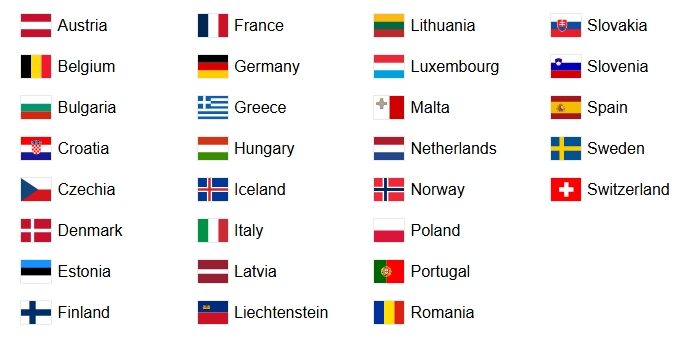
Who the EES actually applies to
The system affects third-country nationals, i.e. people who do not hold the nationality of an EU country or a Schengen associated state.
It applies to both travellers:
- Who require a visa
- And those who are visa-exempt
Provided their stay is of short duration (maximum 90 days in any 180-day period).
What changes at border controls
With the entry into force of the EES, border controls will become digital and biometric.
In practice, this means that at the first border crossing:
- Passport details are recorded
- Fingerprints are taken
- A facial image is captured
On subsequent journeys:
- Only the data already stored is verified
- Crossing the border will be quicker
Furthermore, at many border points there will be automated self-service systems to speed up the process.
What data does the EES system collect?
The EES stores key information for immigration control and security:
- Travel document details
- Dates and places of entry and exit
- Facial image
- Fingerprints
- Refusals of entry (if any)
This record allows the permitted length of stay to be calculated automatically and helps detect potential overstays.
Furthermore, the personal data collected is protected in accordance with European Union data protection regulations, such as the General Data Protection Regulation (GDPR), and may only be used by the competent authorities for specific purposes relating to border control, security and migration management.
Access to this information is restricted and monitored, guaranteeing travellers’ rights, such as access to, rectification or erasure of their data.
Phased roll-out until 2026
Although the system has been operational since 12nd October 2025, its implementation is gradual at all border crossings:
- Phased introduction at airports, ports and land borders
- Full implementation scheduled for 10th April 2026
During this period, traditional procedures may coexist with the new system at some points.
Our commitment
At Fuster & Associates, we help foreign nationals, investors and international residents adapt to regulatory changes in Europe by offering clear and up-to-date legal advice. With the introduction of the EES, having a proper migration plan is essential to avoid non-compliance and optimise every stay within the Schengen Area.
If you need personalised guidance on how this system may affect your specific situation, our team is ready to support you throughout the process.
Contact Fuster & Associates today, stay ahead of the changes and avoid unforeseen issues.
We want to help you navigate all the legal complexities that come with buying a home in Spain, but this article is for informational purposes only and should not be considered legal advice.