The international real estate market is undergoing a period of change. According to the latest statistics from the General Council of Notaries, covering the first half of 2026, property purchases by foreigners in Spain fell by 13% year-over-year, to 62,327 transactions. However, the average price paid rose by 9.4%, reaching 2,644 euros per square meter.
This trend is particularly significant for the Valencian Community, the Region of Murcia, and the province of Almería—markets with a significant presence of international buyers. According to the Notaries’ Council, the Valencian Community accounted for 40.3% of sales by non-resident foreigners during the half-year, Andalusia for 25.3%, and Murcia for 7.8%.
In addition, prices paid by foreign buyers rose by 15.6% in the Valencian Community and by 15.1% in Murcia.
In this context, real estate agencies and developers are facing a market where traditional buyers, such as the British, coexist with other profiles that are generating new inquiries, such as Americans. Their motivations, financing options, and legal requirements can vary greatly.
The British Buyer: Residency Remains a Key Issue
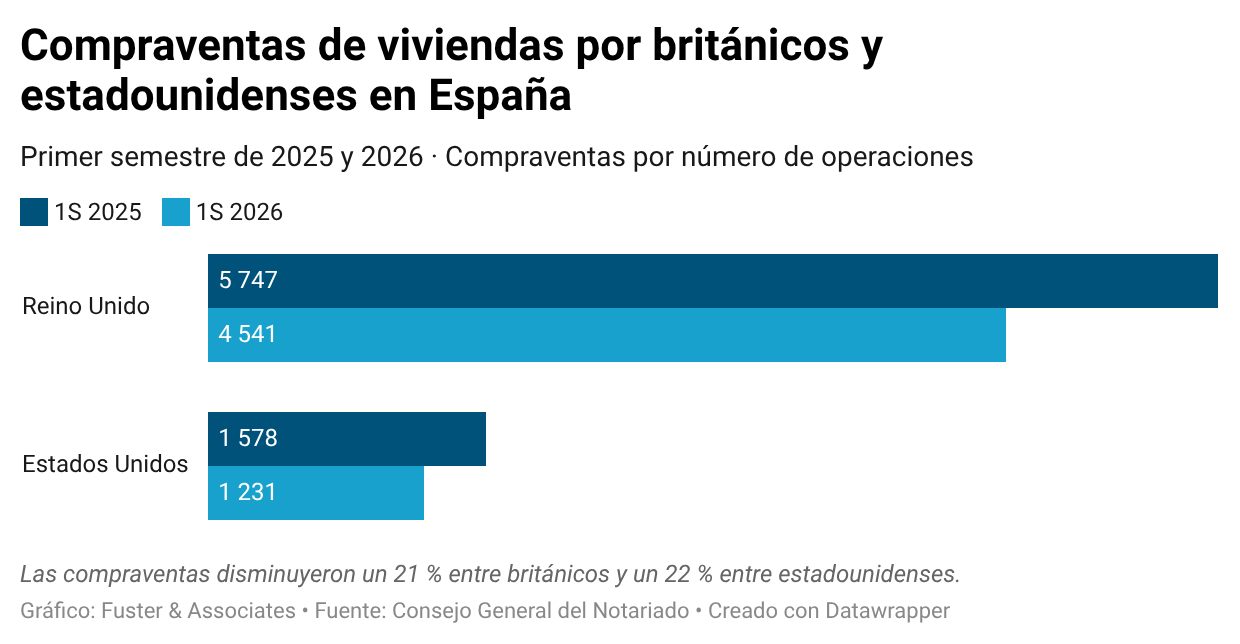
British citizens continue to be one of the main groups of international buyers in Spain. During the first half of 2026, they completed 4,541 property purchases, 21% fewer than in the same period the previous year, although they remained the second-largest foreign nationality by transaction volume.
However, since Brexit, purchasing a home and obtaining authorization to reside in Spain have become separate matters.
British nationals who do not hold a residence permit or a long-term visa are generally subject to a 90-day stay limit within any 180-day period in the Schengen Area.
This circumstance may influence the decisions of those who wish to use their home for extended periods or move permanently to Spain.
For real estate agencies, knowing from the outset how the buyer intends to use the property allows them to anticipate potential immigration needs. Depending on the buyer’s personal circumstances, different residency options can be explored, such as non-lucrative visa or other authorizations provided for under Spanish law.
Planning these matters in advance helps avoid creating false expectations regarding the rights conferred by the purchase of a property.
U.S. Buyers: High Prices, but Fewer Transactions
One profile that is attracting interest among real estate professionals is that of U.S. buyers.
At Fuster & Associates, we are receiving frequent inquiries from U.S. citizens interested in purchasing a home in Spain—a market reality that contrasts with the latest official figures.
According to the Notarial Association, property sales by U.S. citizens fell by 22% during the first half of 2026, to 1,231 transactions. Among non-resident U.S. buyers, the decline was even steeper, at 30.4%.
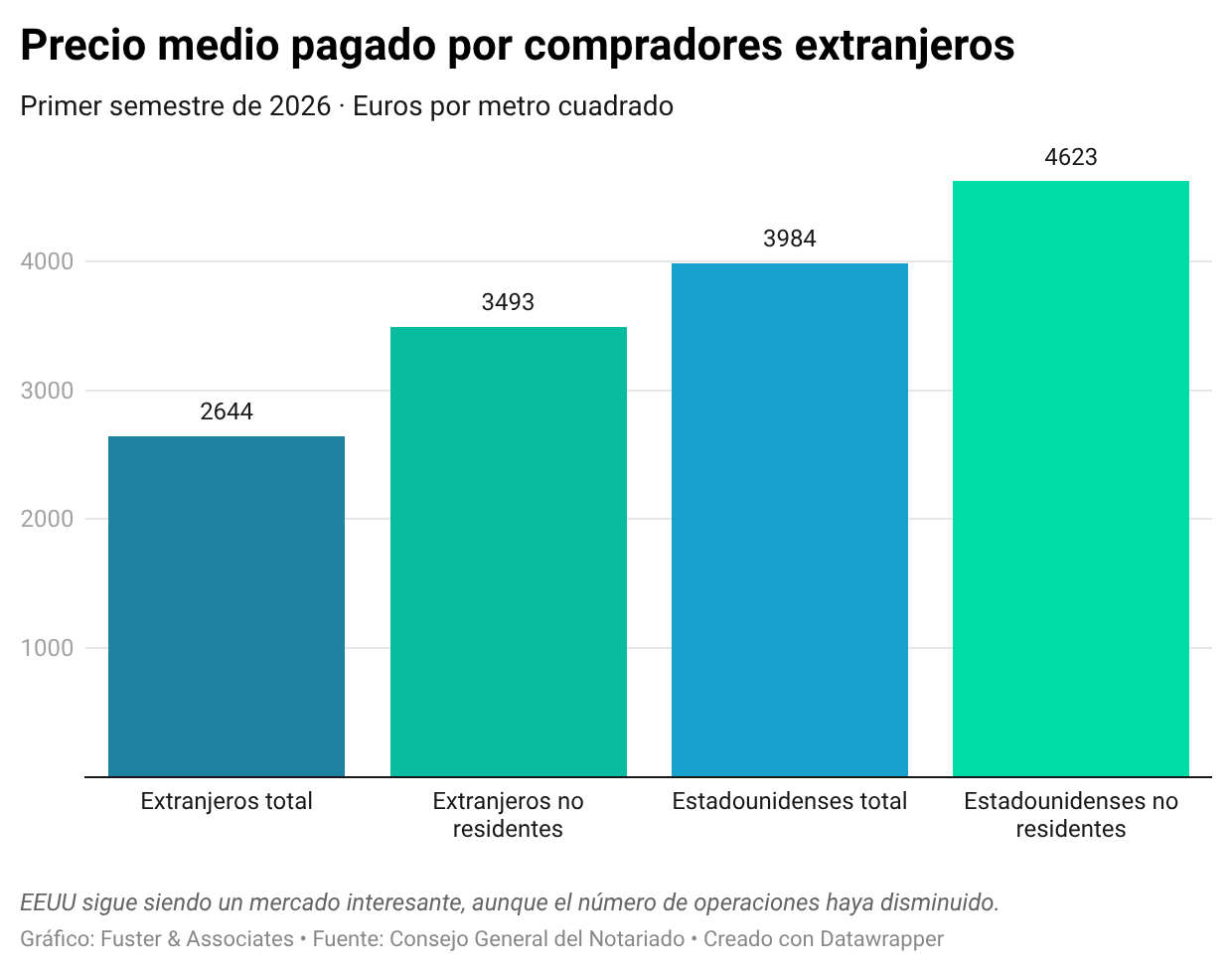
Despite this decline, the United States topped the ranking of nationalities by average price paid, at 3,948 euros per square meter. For non-resident Americans, the figure reached 4,623 euros per square meter.
It is, therefore, a relatively small market in terms of volume, but an interesting one for certain real estate segments.
Why are U.S. property purchases declining?
The drop in transactions contrasts with the interest that professionals working in this market continue to observe. The Notaries’ report does not identify the causes of the decline, although there are economic factors that may help contextualize it.
One of these is the evolution of the exchange rate between the euro and the dollar. According to the U.S. Federal Reserve, the euro rose from an average exchange rate of $1.0356 in January 2025 to $1.1744 in January 2026. This difference, combined with rising Spanish housing prices, increased the cost of purchase in dollars during that period.
Added to this is the elimination, effective April 2025, of the option to apply for new residence permits through real estate investment—known as the Golden Visa—which altered the options available to certain non-EU investors.
Real estate professionals working in the United States are also relaying other concerns they’ve detected among their contacts: caution regarding the upcoming U.S. congressional elections and the perception of Spain conveyed by some media outlets.
These professional observations do not allow for a direct link to be established with the decline in sales, but they serve as a reminder that international investment decisions do not depend solely on price. Confidence in the destination, personal expectations, and legal stability can also influence the decision to buy.
Therefore, even though transactions involving U.S. buyers have declined, it cannot be concluded that interest in Spain has disappeared. One possibility is that certain buyers are postponing their decisions—a hypothesis that cannot yet be confirmed by the available statistics.
7% Mortgages in the United States: An Opportunity for Spain?
Added to this scenario is a recent economic development.
According to Freddie Mac, the average rate for 30-year fixed-rate mortgages in the United States reached 7.40% in October 2026 and, as of October 22, stood at 7.32%, compared to 6.19% a year earlier.
In Spain, the latest data published by the National Institute of Statistics puts the average initial interest rate on home mortgages registered in property registries in August 2026 at 3.08%.
Although both indicators correspond to different markets, products, and financing profiles, they reveal significant differences in mortgage conditions.
Could this situation spark greater interest in the Spanish market? It is a possibility worth monitoring, although there is still no data to show that the recent rise in U.S. mortgage costs is leading to an increase in purchases in Spain.
Furthermore, not all buyers need financing. Some Americans interested in our market have their own funds and can make their purchases without taking out a mortgage.
For those who do need financing, Spanish financial institutions can grant mortgage loans to non-resident U.S. citizens, provided they pass the corresponding creditworthiness assessment.
The terms depend on each institution and the applicant’s profile. Generally, non-resident buyers must plan for a significant down payment, in addition to taxes and closing costs.
The bank may request information regarding income earned in the United States, existing financial obligations, tax returns, and the buyer’s net worth. It is also necessary to assess exchange rate risk when income is received in dollars and mortgage payments must be made in euros.
For real estate agencies and developers, understanding these specifics allows them to better guide transactions from the very beginning.
Buying with cash does not eliminate bank verification requirements
For buyers with sufficient liquidity to purchase a home without financing, there is another issue that warrants special attention: proving the source of the funds.
Spanish anti-money laundering regulations establish identification and verification requirements for certain professionals and entities involved in real estate transactions.
These requirements do not apply exclusively to U.S. buyers, but they take on special importance when large sums are transferred internationally.
Depending on the circumstances and the transaction’s risk level, documents may be requested to verify the source of the funds, such as proof of savings, professional income, the sale of assets, inheritances, or dividends.
Therefore, having the necessary funds to purchase a home does not mean the transaction can be completed immediately.
A lack of documentation or pending verifications can delay the availability of funds and, consequently, the finalization of the sale.
For real estate agents and developers, it is particularly useful to identify these requirements from the outset and coordinate the documentation with legal advisors and banks, thereby avoiding issues once the signing date has been set.
Buying a Home Without Traveling to Spain
Another aspect that facilitates international real estate transactions is the ability to handle much of the buying and selling process remotely.
Meetings with legal advisors, document reviews, property registry checks, contract preparation, and numerous administrative procedures can be coordinated digitally.
It is also possible to finalize a sale through a duly authorized representative using a valid and sufficient power of attorney.
When the power of attorney is executed in the United States before a local notary, it must meet the necessary requirements to be enforceable in Spain, including an apostille and, where applicable, a certified translation.
Transactions financed through a mortgage require additional coordination, as Spanish law establishes specific obligations regarding information disclosure and prior notarial advice that must also be met when a representative is involved.
Remote processing does not eliminate the legal safeguards of the procedure, but it allows the buyer to move forward with numerous formalities without having to travel constantly to Spain.
For agencies and developers marketing homes outside Spain, this option expands their ability to serve international clients and facilitates the organization of transactions.
Understanding the International Buyer: A Competitive Advantage
The latest statistics from the Notarial Association show that the foreign market is not evolving uniformly. Transactions are declining, prices continue to rise, and buyers’ needs vary depending on their nationality, residence, and financial situation.
A British citizen wishing to retire in Spain may primarily need advice on residency options and their tax implications. An American purchasing property from the United States may face issues related to financing, currency exchange, banking documentation, proving the source of funds, or representation through powers of attorney.
In both cases, understanding these specific details from the very first discussions allows us to provide more accurate information and properly coordinate the professionals involved.
For real estate agencies and developers, diversifying into international markets represents an opportunity, but it requires tailoring their approach to each client’s profile.

David Fuster, director of Fuster & Associates
“
In a market with fewer transactions and buyers with increasingly diverse needs, knowledge of their specific legal and economic circumstances can become a key differentiator for the real estate sector.
Director of Fuster & Associates
At Fuster & Associates, we advise international buyers, estate agents and property developers on property transactions throughout Spain, with offices in Valencia, Teulada, Finestrat, La Zenia, Murcia, Los Alcázares and San Juan de los Terreros, Almería.