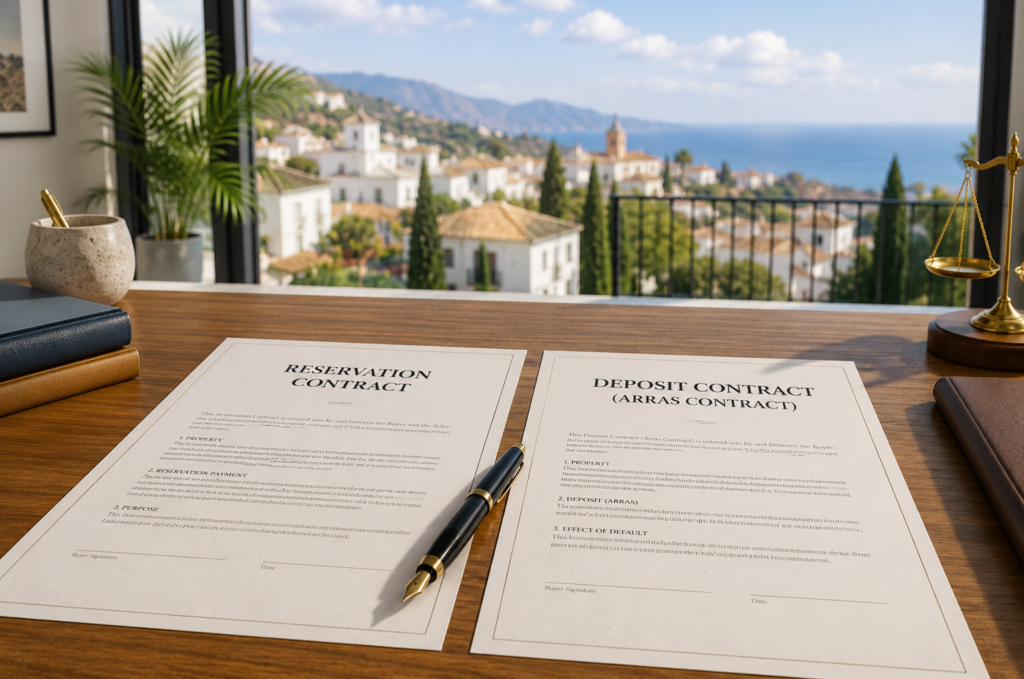
In the Spanish property market, many transactions begin in a rush, under commercial pressure and with a false sense of security. A buyer finds the ‘perfect’ property, pays a sum of money to secure it and signs a document that, at times, they do not even fully understand.
The problem is that not all pre-sale contracts have the same legal standing.
At Fuster & Associates, we frequently see buyers, particularly foreign buyers, who believe they have secured a property when in fact they have signed a simple letter of intent offering little legal protection. In other cases, they discover too late that a deposit contract obliges them to buy even when planning, tax or land registry issues arise.
Understanding the difference between a reservation contract and a deposit contract can prevent significant financial losses.
What is a Reservation Contract?
A reservation contract is a preliminary agreement whereby the buyer pays a sum of money to temporarily take the property off the market.
In practice, it is usually used to:
- Take the property off the market for a few days.
- Give the buyer time to secure financing.
- Allow solicitors to review the property’s legal status.
- Demonstrate a serious intention to purchase.
However, this is where one of the most common mistakes arises: many people believe that a reservation contract is equivalent to a binding sale and purchase agreement, when legally this is not always the case.
The reality is that the content of the document determines its legal effects. Some reservation contracts contain little more than:
- Identification of the parties.
- An indicative price.
- The deposit paid.
- The period for which the property is ‘reserved’.
And that can leave too many aspects unregulated.
The Main Risk of the Reservation Contract
The problem is not the document itself, but how it is drafted.
Some reservation contracts:
- Do not specify what happens if the buyer withdraws.
- Do not indicate whether the deposit is refundable.
- Do not cover hidden charges or planning issues.
- Do not clarify what happens if the seller changes their mind.
- Include ambiguous clauses drafted by estate agents without legal oversight.
The result is usually the same: disputes over the return of the money.
In many cases, the buyer discovers they have paid several thousand euros without any real protection.
What Is a Deposit Contract?
A deposit contract is a much more robust and binding contract.
Unlike a reservation, there is usually a formal commitment to buy and sell between the buyer and seller.
The document typically includes:
- The final price of the property.
- Method of payment.
- Deadlines for completing the title transfer.
- Allocation of costs and taxes.
- Legal consequences of breach.
Furthermore, a deposit usually entails a clear financial penalty if either party breaches the agreement.
The Three Types of Deposit in Spain
One of the aspects least known to many buyers is that not all deposits work in the same way.
1. Penitential deposits
These are the most common in residential transactions.
They allow the contract to be withdrawn:
- The buyer forfeits the amount paid.
- The seller returns double the amount if they breach the contract.
They are regulated by Article 1454 of the Civil Code.
2. Confirmatory deposits
These function as a deposit towards the purchase price.
They do not allow for free withdrawal, and breach may result in:
- Enforcement of performance.
- Claims for damages.
3. Penalty deposits
These include a specific penalty clause for breach of contract.
They may coexist with additional claims depending on how they are drafted.
The Difference That Really Matters: the level of commitment
Although both documents appear similar, the fundamental difference lies in the degree of legal obligation.
| Reservation Contract | Earnest Money Contract (Arras Contract) |
|---|---|
| Usually preliminary and temporary | Legally binding agreement |
| Limited legal regulation | Clearly defines legal obligations |
| May contain ambiguous clauses | Usually specifies penalties for breach |
| Common during the initial negotiation stage | Used once both parties are ready to commit |
| Higher risk of disputes over deposit refunds | Consequences of cancellation are usually predefined |
The Most Costly Mistake: signing before legal due diligence
One of the greatest risks in Spain is signing any document and handing over money before carrying out a full legal review of the property.
Especially in coastal areas and transactions involving foreign buyers, properties still appear with:
- Illegal extensions.
- Communal debts.
- Registration issues.
- Seizures.
- Planning infringements.
- Non-existent or irregular tourist licences.
- Outstanding taxes.
Once a poorly drafted deposit contract has been signed, withdrawing from the transaction can prove extremely costly.
That is why, at Fuster & Associates, we insist on a basic principle: legal due diligence must be carried out before entering into significant contractual obligations.
Which document is most suitable?
It depends on the stage of the transaction and the level of legal certainty available.
A reservation contract may be useful when:
- The property has just been found
- Documentation is still pending
- The solicitor has not yet carried out checks
- The buyer needs to secure financing
A deposit contract is usually advisable when:
- Due diligence has already been completed
- The terms are clear
- Both parties wish to secure the transaction
- There is sufficient legal certainty to proceed to the deed of sale
Legal Assistance from Fuster & Associates
Buying a property in Spain involves much more than finding an attractive home. The true security of the transaction often depends on the documents signed prior to the deed.
The difference between a reservation contract and a deposit contract is not merely a matter of terminology. It can determine:
- whether you will get your money back,
- whether you will be able to cancel the transaction,
- or whether you will end up facing a legal claim.
At Fuster & Associates, we help domestic and international buyers to review contracts, identify hidden risks and ensure that every property transaction is carried out with complete legal certainty, transparency and legal protection.
Because in the property sector, the most costly problems often begin long before the signing at the solicitor’s office.
Contact our team and receive specialist legal advice before making any decision.
We want to help you navigate all the legal complexities that come with your home buying in Spain, but this article is legal information and should not be seen as legal advice.
- View more post about: Purchase Conveyancing